
I have always been the opposite...more volts to push the amps. I am certainly no expert, but the issue I have read of over and over, is that a 12v Lithium battery needs around 14.2 to 14.6 volts input to ensure proper charging.
Most solar panels here are 18v output, so in when the sun is low in the sky an 18v panel will easily fall to less than 14v output which can curb the actual charge to the battery...that effectively reduces the hours in a day, especially during winter in Oz, where a solar panel will send enough voltage to put charge back in to a battery. It could be as little as 3 - 4 hours in the day depending where you are.
Hence I have always wired my panels in series, with 2 x 18v output panels I can get up to 36v in full sunshine, and even as the sun lowers in the sky I will still be getting at least 20v to the MPPT sending charge to the battery. I see effective charge going to the batteries as early as 9am in winter, and still going to after 3pm.
Cloudy days do make a huge difference to input, but I still get a good charge going in most of the day as sun peeps out from time to time.
The panels I have on the roof now are the new "twin cell" type panels rated at 20.6v output...so they apparently can still send effective charge if partially shaded due to the split cell arrangement...(basically each single panel is split in to 2 panels, 50 - 50), in ideal conditions can send around 40v to the MPPT...I have noted an ok voltage to the MPPT even if one of the panels is partially shaded.
If I put out the portable panels I have it can add another 36v to the MPPT input if required...I would have put 3 panels on the roof but just no space.
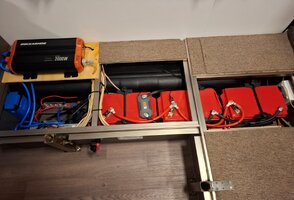
With the 400amps, or 4800w of battery storage I have, the 2 x 200w panels on the roof are really insufficient...but...I have found pumping the up to 40v in I can still recharge the batteries after a previous day of using the inverter to run a coffee machine, boil the kettle, run a hair dryer, as well as the usual night time lighting, TV, phone charging etc.
I always try to find a sunny camp site anyway, if I get a shady spot, and cloud cover as I did at Mount Beauty in the High Country a few months ago, putting out the portable panels...in series...had batteries back to full by just after mid day as the roof panels were still sending some intermittent charge. In stinking days I can opt for shade and use the portable panels out in the sun with good effect.
The MPPT I have has a max of 80v input or 450w.
The argument I guess for parallel over series is a personal preference...yes series makes for one big solar panel so any shaded part of one panel will affect the whole output...parallel can have a shaded panel and the remaining panel or panels will still send some charge.
Most solar panels here are 18v output, so in when the sun is low in the sky an 18v panel will easily fall to less than 14v output which can curb the actual charge to the battery...that effectively reduces the hours in a day, especially during winter in Oz, where a solar panel will send enough voltage to put charge back in to a battery. It could be as little as 3 - 4 hours in the day depending where you are.
Hence I have always wired my panels in series, with 2 x 18v output panels I can get up to 36v in full sunshine, and even as the sun lowers in the sky I will still be getting at least 20v to the MPPT sending charge to the battery. I see effective charge going to the batteries as early as 9am in winter, and still going to after 3pm.
Cloudy days do make a huge difference to input, but I still get a good charge going in most of the day as sun peeps out from time to time.
The panels I have on the roof now are the new "twin cell" type panels rated at 20.6v output...so they apparently can still send effective charge if partially shaded due to the split cell arrangement...(basically each single panel is split in to 2 panels, 50 - 50), in ideal conditions can send around 40v to the MPPT...I have noted an ok voltage to the MPPT even if one of the panels is partially shaded.
If I put out the portable panels I have it can add another 36v to the MPPT input if required...I would have put 3 panels on the roof but just no space.
With the 400amps, or 4800w of battery storage I have, the 2 x 200w panels on the roof are really insufficient...but...I have found pumping the up to 40v in I can still recharge the batteries after a previous day of using the inverter to run a coffee machine, boil the kettle, run a hair dryer, as well as the usual night time lighting, TV, phone charging etc.
I always try to find a sunny camp site anyway, if I get a shady spot, and cloud cover as I did at Mount Beauty in the High Country a few months ago, putting out the portable panels...in series...had batteries back to full by just after mid day as the roof panels were still sending some intermittent charge. In stinking days I can opt for shade and use the portable panels out in the sun with good effect.
The MPPT I have has a max of 80v input or 450w.
The argument I guess for parallel over series is a personal preference...yes series makes for one big solar panel so any shaded part of one panel will affect the whole output...parallel can have a shaded panel and the remaining panel or panels will still send some charge.
Last edited: