

I have at last added the 3rd battery to the battery pack in my JJOB 17.55-1. When I originally upgraded the batteries from AGM to Lithium in April '23 prior to doing the Lap, I saved close to 40kg in weight! The new regulations for Lithium batteries came in to force in November 2023.
I only installed two of the three 135amp Lithiums I had bought as at the time I just couldn't figure out how to fit the third battery in the space under the dinette as it is not very big at all...so just fitted the two batteries in. Besides having the van in storage as I had no where to park it, any mods were difficult to carry out.
The space was so tight even with two batteries that I had to mount the new MPPT in the drawer beside so I could open the drawer to view the readout...no more drama than opening a cupboard though really. The original setup was rushed as well so it didn't have the required fuses either.
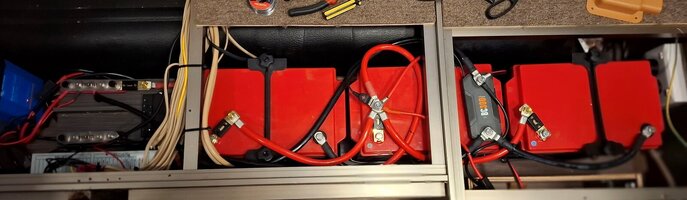
I have now cut out a divider that sat between the spaces, put there I'd say as the original AGM was a single 100amp battery so the space beside nearer the power point was usable storage. This enabled me to put the three batteries end to end. The space is just wide enough for the batteries and clamps, and just high enough to clear them. The frame work is all metal so is pretty sound, but there is no seating on top anyway.
Unfortunately though due to this layout I have had to connect the main output to the centre battery which isn't ideal, but is ok, as the lead run from the negative terminal at one end of the pack to the Busbar at the other would have been way too long...had I tried to connect positive at one end and negative at the other.
Anyway...photo of the new setup...
I now have the 3 x 135amp Lithiums I originally had planned...405amps, which realistically gives me around 325amps usable. My system is based around 300amp output, I have a 300amp Bluetooth enabled Shunt to send info to the JHub reader my van came with, as the BMPRO BMS is only a 12v distribution point now being I have a 30amp Victron Charger to carry out the battery charging role now when on mains.
The space is so tight I have had to use ANL type fuses due to the battery layout having to be length ways not side by side. So each 135amp battery now has a 100amp fuse at the terminal, all cabled to a 300amp Isolater switch which then goes via another 50amp ANL fuse to the 150amp positive Busbar.
The extra red leads going to the positive in the photo are now gone, they were the positives from the battery charger and the solar panels...all now to the busbar.
The area is now fully sealable, and I do have it vented at one end. Being the original mods and replacement of the AGM's was done prior to the new requirements being in place I am ok imo. But, yes it has again been modified I know so by the letter it should be made to fully comply with the new regs...well it is better than it was....and to fully comply would be nigh on impossible anyway due to the small space...and I wasn't going to move it all under the bed with metal boxes...and there is no room to sling it all underneath either. I am sure we won't see any inspections happening in caravan parks and the like to make sure electrical systems comply anyway as the new requirements are not retrospective. The new regs were more to ensure new vans met certain standards.
This just about completes my offgrid electrics...with the two new 200w solar panels on the roof giving me 400w, though wired in series giving me around 40v in to the MPPT, though that will be too light to charge the new battery pack fully if down in amps, so I can easily put out the other 2 x 200w portable panels giving me a series / parallel setup of maybe 800w or 80v, as all wired in series. (The old panel wattage being double the battery amperage rule of thumb is about right)
I've now got a 2000w Inverter to fit, it will be behind the swivel seats above where the wheel arch is...just have some figuring out to do with that fitment...
I only installed two of the three 135amp Lithiums I had bought as at the time I just couldn't figure out how to fit the third battery in the space under the dinette as it is not very big at all...so just fitted the two batteries in. Besides having the van in storage as I had no where to park it, any mods were difficult to carry out.
The space was so tight even with two batteries that I had to mount the new MPPT in the drawer beside so I could open the drawer to view the readout...no more drama than opening a cupboard though really. The original setup was rushed as well so it didn't have the required fuses either.
I have now cut out a divider that sat between the spaces, put there I'd say as the original AGM was a single 100amp battery so the space beside nearer the power point was usable storage. This enabled me to put the three batteries end to end. The space is just wide enough for the batteries and clamps, and just high enough to clear them. The frame work is all metal so is pretty sound, but there is no seating on top anyway.
Unfortunately though due to this layout I have had to connect the main output to the centre battery which isn't ideal, but is ok, as the lead run from the negative terminal at one end of the pack to the Busbar at the other would have been way too long...had I tried to connect positive at one end and negative at the other.
Anyway...photo of the new setup...
I now have the 3 x 135amp Lithiums I originally had planned...405amps, which realistically gives me around 325amps usable. My system is based around 300amp output, I have a 300amp Bluetooth enabled Shunt to send info to the JHub reader my van came with, as the BMPRO BMS is only a 12v distribution point now being I have a 30amp Victron Charger to carry out the battery charging role now when on mains.
The space is so tight I have had to use ANL type fuses due to the battery layout having to be length ways not side by side. So each 135amp battery now has a 100amp fuse at the terminal, all cabled to a 300amp Isolater switch which then goes via another 50amp ANL fuse to the 150amp positive Busbar.
The extra red leads going to the positive in the photo are now gone, they were the positives from the battery charger and the solar panels...all now to the busbar.
The area is now fully sealable, and I do have it vented at one end. Being the original mods and replacement of the AGM's was done prior to the new requirements being in place I am ok imo. But, yes it has again been modified I know so by the letter it should be made to fully comply with the new regs...well it is better than it was....and to fully comply would be nigh on impossible anyway due to the small space...and I wasn't going to move it all under the bed with metal boxes...and there is no room to sling it all underneath either. I am sure we won't see any inspections happening in caravan parks and the like to make sure electrical systems comply anyway as the new requirements are not retrospective. The new regs were more to ensure new vans met certain standards.
This just about completes my offgrid electrics...with the two new 200w solar panels on the roof giving me 400w, though wired in series giving me around 40v in to the MPPT, though that will be too light to charge the new battery pack fully if down in amps, so I can easily put out the other 2 x 200w portable panels giving me a series / parallel setup of maybe 800w or 80v, as all wired in series. (The old panel wattage being double the battery amperage rule of thumb is about right)
I've now got a 2000w Inverter to fit, it will be behind the swivel seats above where the wheel arch is...just have some figuring out to do with that fitment...


